- Details
- Written by: Jefferson Otonbara Imgbi
- Category: Character Studies
- Hits: 2
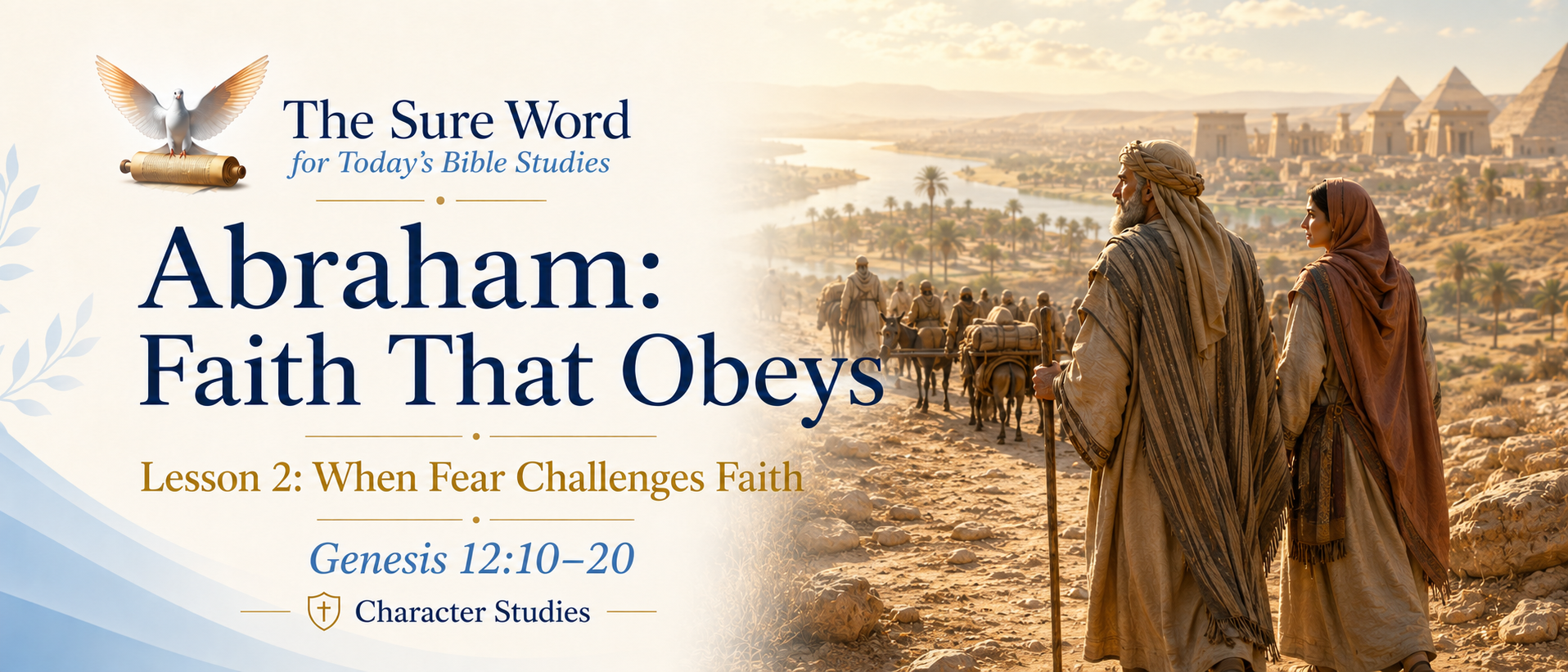
Abraham: Faith That Obeys
Category: Character Studies
Lesson 2: When Fear Challenges Faith
Primary Passage: Genesis 12:10–20
Study Level: Foundation
Estimated Study Time: 20–30 minutes
Learning Objective
By the end of this lesson, you should be able to explain how fear can weaken judgement, influence decisions and lead to partial truth. You should also identify practical ways to respond to pressure with faith, honesty and dependence on God.
Key Bible Verse
“And he said unto Sarai his wife, Behold now, I know that thou art a fair woman to look upon.”
Genesis 12:11, KJV
Sound Biblical Teaching
Shortly after Abram entered Canaan, the land experienced a severe famine:
“And there was a famine in the land: and Abram went down into Egypt to sojourn there; for the famine was grievous in the land.”
Genesis 12:10, KJV
Abram had obeyed God by leaving Haran and travelling to Canaan. However, obedience did not protect him from hardship. The presence of famine did not mean that Abram had missed God’s direction. It meant that his growing faith would face a new test.
The Bible does not record God instructing Abram to travel to Egypt. It simply states that Abram went there because the famine was severe. His decision may have appeared practical, but the passage reveals that fear soon became the dominant influence over his actions.
As Abram approached Egypt, he became concerned that the Egyptians would desire Sarai because of her beauty. He feared that they might kill him while allowing her to live. Abram therefore instructed Sarai to say that she was his sister:
“Say, I pray thee, thou art my sister: that it may be well with me for thy sake; and my soul shall live because of thee.”
Genesis 12:13, KJV
Sarai was Abram’s half-sister, as Genesis 20:12 later explains. However, presenting only that part of the truth concealed the fact that she was also his wife. Abram used partial truth to create a misleading impression.
When they entered Egypt, Pharaoh’s officials noticed Sarai and praised her beauty. She was taken into Pharaoh’s household. Pharaoh treated Abram well because of her and gave him livestock and servants.
Abram’s plan appeared to protect him and increase his possessions, but it placed Sarai in danger and brought judgement upon Pharaoh’s household.
“And the LORD plagued Pharaoh and his house with great plagues because of Sarai Abram’s wife.”
Genesis 12:17, KJV
Pharaoh confronted Abram and returned Sarai to him. Abram was then ordered to leave Egypt with his wife and possessions.
This account reveals a serious contrast. Abram had trusted God enough to leave his country, but he struggled to trust God when his life appeared threatened. His faith was real, but it was still developing.
The passage does not present Abram as perfect. It shows that even a person who has responded to God’s call can still make decisions controlled by fear. God protected His promise despite Abram’s failure, but Abram’s actions still created danger, confusion and unnecessary consequences.
Clear Explanation
Obedience does not remove every difficulty
Abram had followed God, yet he encountered famine.
Many people assume that hardship always means they have made the wrong decision. They believe that obedience should produce immediate comfort, success and stability.
Scripture does not support that conclusion.
God may lead you into a purpose that includes uncertainty, resistance, delay or temporary lack. Difficulty should cause you to seek God more carefully, not automatically abandon His direction.
The famine tested whether Abram would continue trusting the God who called him.
Pressure can expose areas where faith still needs growth
Abram demonstrated strong faith when he left Haran, but fear became visible when he approached Egypt.
A courageous decision in one season does not mean you have conquered every fear. Different pressures expose different weaknesses.
You may trust God with your ministry but struggle to trust Him with money. You may trust Him with your career but become fearful concerning your family. You may speak confidently in public but make anxious decisions in private.
Do not hide the area where fear challenges your faith. Identify it and bring it before God.
Fear encouraged Abram to imagine the worst
Abram believed the Egyptians would kill him because of Sarai. The passage does not show that anyone had threatened him before he created his plan.
Fear often presents a possible outcome as though it is certain.
It says:
- Something terrible will happen.
- You will lose everything.
- No one will help you.
- You must protect yourself immediately.
- Honesty will make the situation worse.
- God will not act in time.
When you accept these conclusions without testing them, fear begins directing your behaviour.
Faith does not deny risk. Faith assesses the situation without allowing imagined danger to replace truth, wisdom and dependence on God.
Partial truth can still produce deception
Abram’s statement about Sarai contained factual information, but it concealed the most important fact. She was his wife.
Truthfulness involves more than avoiding technically false words. It requires honest communication that does not deliberately create a false understanding.
People sometimes defend misleading conduct by saying:
- “I did not actually lie.”
- “They did not ask me directly.”
- “What I said was technically true.”
- “I only left out part of the story.”
These explanations do not remove the intention to mislead.
Faith and integrity must work together. Do not use selected facts to manipulate how others understand a situation.
Fear can make you protect yourself at another person’s expense
Abram’s plan focused on preserving his own life:
“That it may be well with me for thy sake.”
His fear caused him to place Sarai in a vulnerable position. Instead of protecting his wife, he asked her to participate in a plan designed primarily for his security.
Fear can narrow your thinking until you focus only on personal survival. You may then ignore how your actions affect your spouse, children, colleagues, church or community.
Before making a decision under pressure, ask:
- Who could be harmed by this choice?
- Am I transferring my risk to someone else?
- Am I protecting myself while exposing another person?
- Is fear reducing my concern for others?
Faith remains responsible for the wellbeing of people affected by its decisions.
Material gain does not prove that a decision was right
Pharaoh gave Abram livestock and servants. Abram’s possessions increased, but the method that produced the increase was morally compromised.
An outcome can appear profitable while the process remains wrong.
Do not judge a decision only by what you gained. Examine whether you acted honestly, responsibly and biblically.
Success without integrity is not spiritual success.
God remained faithful despite Abram’s failure
God intervened to protect Sarai and preserve His covenant purpose.
This does not mean that Abram’s behaviour was acceptable. It demonstrates that God’s faithfulness is greater than human weakness.
God did not abandon Abram after this failure. Abram continued his journey and received further opportunities to grow. This gives hope to every believer who has allowed fear to influence a decision.
Failure does not need to become your final identity. Acknowledge what happened, learn from it, correct what you can and return to faithful obedience.
Practical Application
1. Identify the fear behind the decision
Fear does not always announce itself clearly. It can appear as urgency, excessive caution, defensiveness, control or secrecy.
When you feel pressured to make a decision, ask:
- What exactly am I afraid will happen?
- What evidence supports this fear?
- Am I responding to facts or assumptions?
- Has fear become more influential than God’s Word?
- Would I make the same decision if I felt secure?
Naming the fear reduces its hidden control.
2. Do not make major decisions from panic
Abram formed his plan before entering Egypt because he had already accepted a fearful conclusion.
Pause before acting under intense pressure. Pray, gather accurate information and seek mature counsel. Give yourself enough space to distinguish genuine danger from imagined outcomes.
Where immediate safety is at risk, take responsible protective action. However, do not allow panic to justify deception or reckless behaviour.
3. Tell the complete truth
Examine whether you are presenting information honestly.
This applies to:
- Marriage
- Employment
- Business agreements
- Financial matters
- Ministry
- Applications
- Legal processes
- Family discussions
- Online communication
Do not construct a technically accurate statement that is designed to produce a false belief.
Speak truth with wisdom, respect and courage.
4. Consider who will carry the consequences
Every decision creates an effect beyond you.
Abram’s plan affected Sarai, Pharaoh and Pharaoh’s household. Before acting, examine the likely impact on others.
Ask trusted people how your decision may affect them. Listen without becoming defensive. Responsible faith does not treat other people as tools for personal protection.
5. Return to God when fear exposes weakness
Do not respond to failure by hiding from God. Return to prayer and Scripture.
Confess where fear controlled you. Accept responsibility without condemning yourself permanently. Ask God for wisdom to correct the damage and build a stronger response for the future.
The goal is not to pretend that you never struggle. The goal is to grow so that fear has less authority over your next decision.
6. Prepare a faith response before the next crisis
Pressure can limit clear thinking. Develop a response plan before another difficult situation arises.
Your plan might include:
- Pause before making a major commitment.
- Pray about the situation.
- Write down the verified facts.
- Identify fearful assumptions.
- Review relevant Scripture.
- Speak with a trustworthy adviser.
- Consider the impact on others.
- Choose the honest and responsible action.
Preparation strengthens disciplined faith.
Reflection
Answer these questions honestly.
- Why did Abram travel to Egypt?
- What did Abram fear would happen?
- How did fear influence his treatment of Sarai?
- Why was Abram’s statement about Sarai misleading?
- What does this passage teach about the difference between partial truth and honesty?
- Have you ever imagined a negative outcome and treated it as certain?
- In what area of your life does fear most often challenge your faith?
- Has self-protection ever caused you to overlook another person’s wellbeing?
- Are you currently withholding important information from someone who needs the complete truth?
- What practical step will help you respond differently the next time fear rises?
Prayer
Heavenly Father, thank You for showing me that faith must guide my decisions when pressure and fear arise. Reveal every area where fear has influenced my thinking, communication and behaviour. Forgive me for the times I have relied on deception, control or self-protection instead of trusting You. Give me courage to speak truth, act with integrity and consider how my choices affect others. Teach me to pause, pray and seek wisdom before I respond. Strengthen my faith so that fear no longer controls my actions. In Jesus’ name, Amen.
Action
Identify one present situation in which fear may be influencing your judgement.
Complete the following statements:
The situation I am facing is:
The outcome I fear is:
The verified facts are:
The assumptions I have made are:
The honest and responsible action I need to take is:
The person whose wellbeing I must also consider is:
Take one responsible action within the next twenty-four hours. This may involve praying, correcting a misleading statement, seeking wise counsel, apologising or communicating the complete truth.
Fear tries to control the outcome. Faith chooses truth, wisdom and obedience while trusting God with the result.
- Details
- Written by: Jefferson Otonbara Imgbi
- Category: Character Studies
- Hits: 2
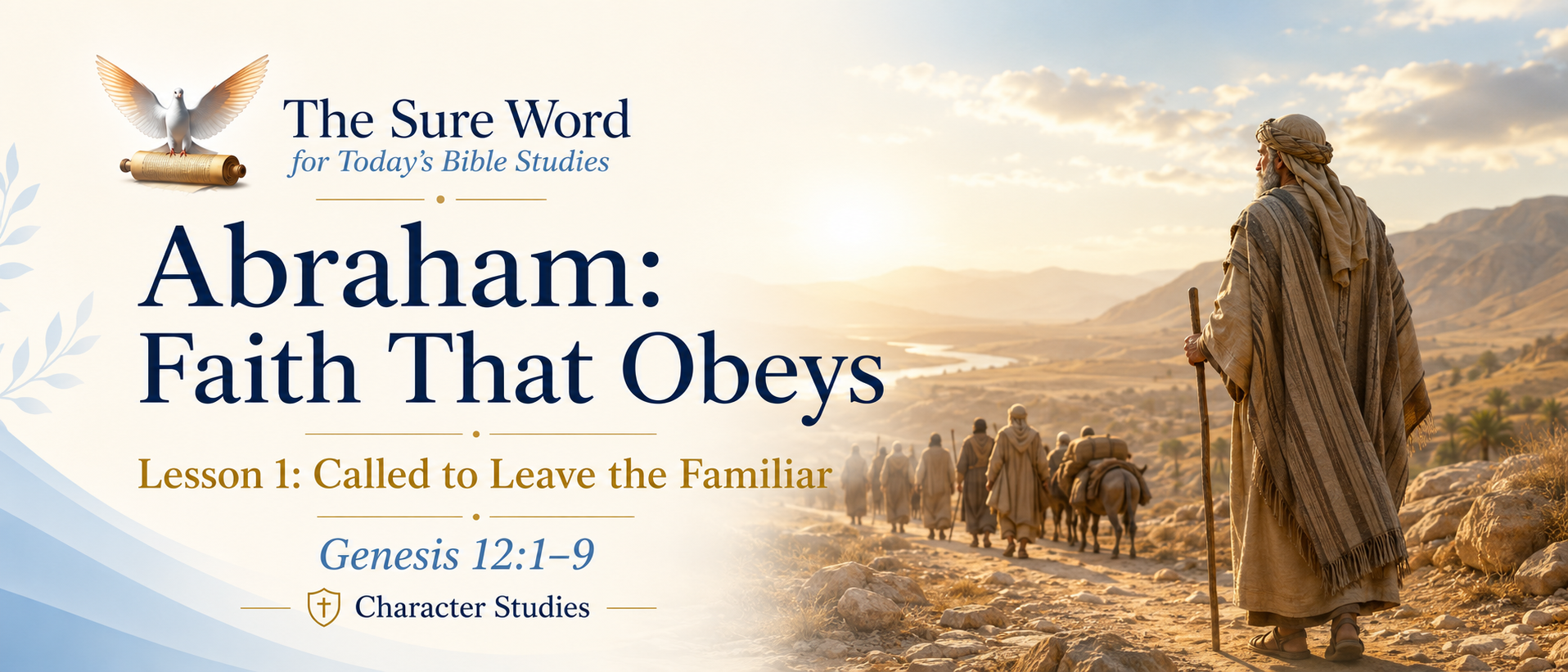
Abraham: Faith That Obeys
Category: Character Studies
Lesson 1: Called to Leave the Familiar
Primary Passage: Genesis 12:1–9
Study Level: Foundation
Estimated Study Time: 20–30 minutes
Learning Objective
By the end of this lesson, you should be able to explain why biblical faith requires obedience before every detail becomes clear. You should also identify one practical step God is calling you to take.
Key Bible Verse
“So Abram departed, as the LORD had spoken unto him.”
Genesis 12:4, KJV
Sound Biblical Teaching
Genesis 12 begins with a direct instruction from God to Abram:
“Get thee out of thy country, and from thy kindred, and from thy father’s house, unto a land that I will shew thee.”
Genesis 12:1, KJV
God called Abram to leave three areas of familiarity:
- His country
- His relatives
- His father’s household
These represented Abram’s established environment, relationships, security and way of life. God was not merely changing Abram’s location. He was beginning a new spiritual journey through which Abram would learn to trust God above everything familiar.
God did not initially give Abram the name of his final destination. He said, “unto a land that I will shew thee.” Abram received enough instruction to begin, but not enough information to control the whole journey.
God then gave Abram several promises:
“And I will make of thee a great nation, and I will bless thee, and make thy name great.”
Genesis 12:2, KJV
God promised to:
- Make Abram into a great nation
- Bless him
- Make his name great
- Make him a blessing to others
- Bless those who blessed him
- Judge those who treated him with contempt
- Bless all families of the earth through him
These promises were not limited to Abram’s personal success. God intended to work through Abram so that others would receive blessing. This purpose ultimately points towards Jesus Christ, through whom salvation became available to all nations.
Abram responded through action:
“So Abram departed, as the LORD had spoken unto him.”
Genesis 12:4, KJV
This sentence reveals the central message of the lesson. Abram heard God, believed God and moved according to God’s instruction.
Abram was seventy-five years old when he left Haran. His age did not prevent him from beginning again. His established life did not become an excuse. His unanswered questions did not stop his obedience.
He gathered his household and possessions and travelled towards Canaan. When he arrived at Shechem, God appeared to him and confirmed:
“Unto thy seed will I give this land.”
Genesis 12:7, KJV
Abram responded by building an altar. He later moved towards the area between Bethel and Hai, built another altar and called upon the name of the Lord.
Abram’s journey was therefore marked by two visible actions:
- Movement in obedience
- Worship along the way
Clear Explanation
God’s call required separation
God called Abram away from what had previously defined his life. This did not mean that his country or family had no value. It meant that God’s purpose now required Abram to place divine instruction above familiarity.
There are seasons when growth requires separation from an environment, pattern, relationship, habit or mindset that cannot accompany you into the next stage of your calling.
Separation does not always mean physically leaving a place. It can mean rejecting old thinking, ending an unhealthy practice or refusing to remain controlled by fear.
God gave direction without giving every detail
Abram knew that he had to go, but he did not yet know the full destination.
Many people delay obedience because they want God to reveal the entire plan first. They want every question answered, every risk removed and every outcome guaranteed.
That is not how faith usually operates.
God often reveals the next step before He reveals the whole journey. Your responsibility is not to know everything. Your responsibility is to obey what God has made clear.
Faith does not require complete information. Faith requires confidence in God’s character.
God connected blessing with responsibility
God promised to bless Abram, but He also said that Abram would become a blessing.
Biblical blessing is not designed to stop with the recipient. God gives resources, wisdom, opportunities, influence and spiritual strength so that His people can serve others.
Ask more than, “What will I receive?”
Also ask, “Who will benefit from what God places in my hands?”
Abram’s obedience was immediate and practical
Genesis 12:4 does not say that Abram only agreed with God. It says that he departed.
Biblical faith produces a response. Agreement without action does not complete obedience.
Abram had to organise his household, gather his possessions and begin travelling. His faith became visible through practical decisions.
Your obedience may require you to:
- Begin a neglected assignment
- End an unhealthy pattern
- Apologise to someone
- Forgive an offence
- Change how you manage your time
- Apply for an opportunity
- Seek wise support
- Return to prayer and Scripture
- Serve where God has placed you
- Take responsibility for a delayed decision
Do not reduce obedience to a feeling. Turn conviction into action.
Abram built altars during the journey
Abram did not become so focused on reaching the destination that he neglected his relationship with God. He built altars and called upon the Lord.
The altar represented worship, gratitude, surrender and remembrance.
You also need spiritual altars during seasons of change. These are consistent moments when you pray, study Scripture, remember God’s faithfulness and surrender your plans to Him.
Progress without worship can produce pride. Activity without prayer can produce exhaustion. Keep God at the centre of the journey.
Practical Application
1. Identify what has become too familiar
Familiarity can provide stability, but it can also make change feel threatening. You may remain in an unproductive situation simply because you understand it.
Ask yourself:
- What am I holding because it feels safe?
- What have I outgrown spiritually?
- What habit is limiting my development?
- Where am I choosing comfort over obedience?
Do not abandon responsibilities carelessly. Seek biblical wisdom and act responsibly. However, do not use caution as a permanent excuse for refusing to move.
2. Stop demanding the entire map
You may not know how everything will work. Begin with what you already know.
If God has shown you that you need to pray, begin praying.
If you need to repair a relationship, make the first respectful approach.
If you need to study, register, write, serve or prepare, take the first responsible step.
Clarity often increases after movement begins.
3. Separate God’s instruction from emotional comfort
Obedience can feel uncomfortable because it moves you beyond what you know. Discomfort does not automatically mean that a decision is wrong.
Test your direction through Scripture, prayer and wise counsel. Once the instruction becomes clear, do not allow fear to have the final word.
4. Build worship into your progress
Do not only pray when you need instructions. Worship God while you travel.
Record answered prayers. Thank God for small progress. Mark important moments of growth. Return regularly to the promises that strengthened you.
Your altar may be a consistent morning prayer time, a journal, a weekly period of reflection or a disciplined Bible study routine.
5. Remember that your obedience affects others
Abram’s obedience became part of a plan that extended beyond his lifetime.
Your decisions can influence your children, family, church, workplace and community. A faithful step today may create opportunities for people you have not yet met.
Do not underestimate the reach of one obedient decision.
Reflection
Take time to answer these questions honestly.
- What did God require Abram to leave?
- Why did Abram need faith before beginning his journey?
- What does Abram’s immediate departure teach you about obedience?
- Is there an instruction you understand but have not acted upon?
- What fear has been preventing you from moving forward?
- What familiar habit, environment or mindset may be restricting your growth?
- How can your obedience become a blessing to other people?
- What spiritual altar do you need to establish or rebuild?
- What is one clear step you can take within the next twenty-four hours?
Prayer
Heavenly Father, thank You for calling me into a life of faith and obedience. Give me the courage to leave every pattern, fear and limitation that prevents me from following You fully. Teach me to trust Your character when I cannot see the entire journey. Help me to obey what You have already made clear. Keep my heart centred on You as I move forward. Let my life become a blessing to my family, community and everyone You place within my influence. In Jesus’ name, Amen.
Action
Write down one instruction, responsibility or decision that you have delayed.
Complete these statements:
God is calling me to:
The fear or excuse holding me back is:
My first act of obedience will be:
I will complete this action by:
Take that step within the time you have written. Do not wait for perfect conditions. Begin responsibly, prayerfully and confidently.
Faith does not wait until the entire road becomes visible. Faith obeys God and takes the next clear step.